
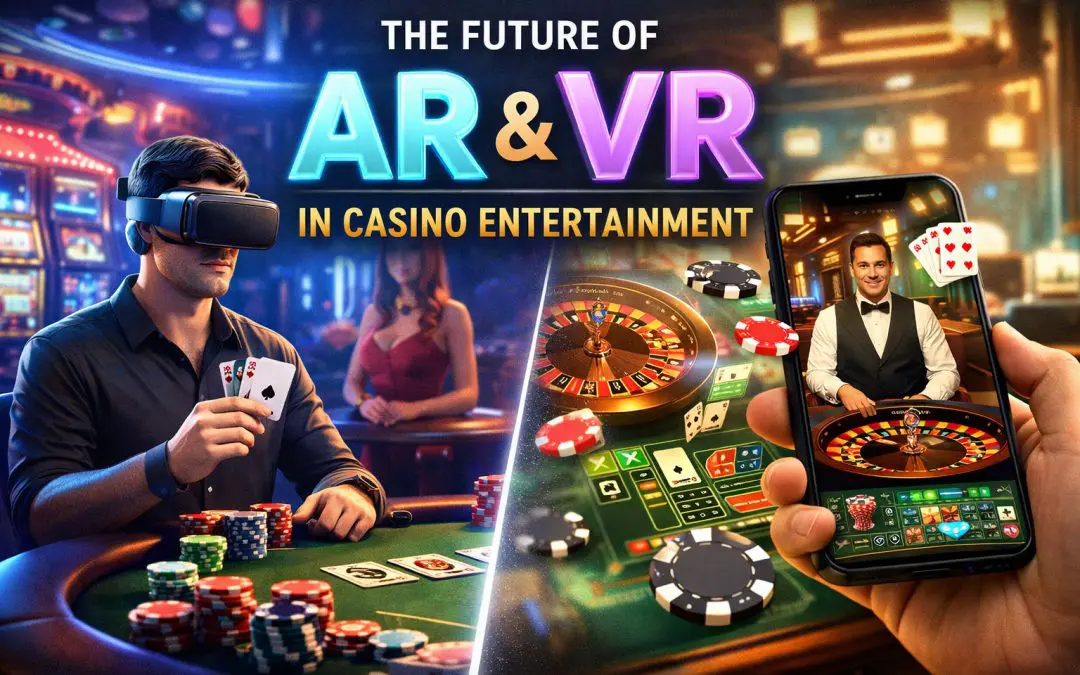
Immersive gaming has always driven the direction of casino gaming — from the velvet rope-lined entrances of European casinos to the neon-drenched lights of Las Vegas. Every aspect of casino design is intended to envelop players in a larger-than-life experience; a sense of being in a special place. Augmented reality (AR) casino gaming and virtual reality (VR) casino gaming continue this trend, except the boundaries of the casino are now only limited by the imagination and resources of the player.
As VR and AR headsets such as Oculus Quest and Apple Vision Pro have advanced to the point of mainstream usability, immersive gaming has shifted from theory to practical application.
Active communities currently exist within platforms such as PokerStars VR and metaverse casino platforms including Decentraland Casino, which attract users who log in for short periods of time after work, and users who spend the entire evening chatting and interacting with the virtual environment.
The debate is no longer centered upon whether or not AR and VR casino gaming will be developed, the current focus is centered upon how far these technologies will advance, how quickly, and what implications will arise when casino gaming becomes spatially immersive.
What Are AR And VR Casino Technologies?
Both AR and VR have their roots in similar concepts and both are used to create a deeper level of immersion for players, however, they function in diametrically opposed ways.
Augmented Reality (AR) enhances the real world by adding layers of digital content to the physical world. For instance, a player sitting at their kitchen table can point their phone at the surface of the table and see a fully animated roulette wheel spinning on the table. The physical environment remains visible but the addition of the digital animation provides motion, sound, and interaction.
Virtual Reality (VR) removes the player entirely from their physical environment. Once a player enters a VR headset, they are transported to a completely virtual casino environment. In this environment, players interact with virtual versions of avatars, tables, dealers and ambient sounds.
In summary, AR enhances the real world while VR builds new worlds.
Why AR Overlays Reality While VR Builds New Worlds
Because AR enhances the real world while VR builds new worlds, AR works best for players looking for convenience. Players can access AR-based casino games anywhere they have access to their phone. The process of accessing AR-based casino games is quick and easy and does not isolate the player from their surroundings. Therefore, the overall experience feels casual and seamless.
VR casino experiences, on the other hand, strive for depth rather than convenience. Players enter a fully-simulated version of a casino. They can walk between tables, examine cards closely, and interact with dealers and other players using their voice and hand gestures.
Due to these differences in design, each technology lends itself to different types of casino gaming behaviors. AR lends itself to integrating into players’ everyday lives. VR lends itself to replacing everyday activities. At least for the duration of the player’s VR experience.
The First Generation of Real VR Casinos
Although early VR casino gaming experiences had many flaws, they showed one thing clearly: players did not merely tolerate virtual casino environments. Players enjoyed them.
PokerStars VR was one of the first successes of the industry. In PokerStars VR, players compete against each other at virtual poker tables represented by avatars. Players can converse with one another, bluff, and gesture as if they were competing at a physical poker table. Due to the high level of social interaction, players often remained logged in to PokerStars VR longer than they would have at a traditional online poker site.
Another type of VR casino experience was created by SlotsMillion VR. SlotsMillion VR provided players with a large-scale virtual casino environment filled with virtual reality slots, themed rooms, and interactive slot machine cabinets. Players could walk up to a slot cabinet, lean in and simulate pulling the lever using motion controls.
More recent examples of VR casino experiences include Vive Casino and platforms that operate within Meta Horizon Worlds. These platforms allowed players to enter fully-realized virtual casino environments with architecture, lighting and sound design similar to that found in real-world casino gaming environments.
All of these environments rely on multiple related technologies including:
- Spatial audio to allow players to hear other players based on their position.
- Motion tracking to translate physical gestures into virtual actions.
- Avatar systems to represent players visually.
- Haptic feedback to provide players with physical sensations during their interaction.
- Persistent environments to remain available to players continuously regardless of whether they log in or out.
None of these technologies individually create immersion. When combined, however, they create a surprising amount of immersion.
Why Does Immersion Change How Players Behave?
Online casinos typically exist as flat-screen interfaces. Players click on buttons. Animations occur. The experience is efficient, but it lacks presence.
VR is entirely different.
When players perceive themselves to be physically immersed in the gaming experience, they react differently to the game. They move more slowly. They pay more attention to the environment. They interact with other players socially rather than solely transactionally.
Conversations occur naturally among poker players as they pass cards back and forth. Players observe each other playing slot reels with curiosity rather than necessity.
A VR Blackjack player recently reported spending 30 minutes at a Blackjack table without placing a single bet. He spent his time observing the environment and chatting. This is a behavior pattern that rarely occurs in traditional online casinos.
Immersion extends session length. However, it does so without relying on bonuses exclusively. The environment itself becomes the reason players continue to play.
Immersion Extends Session Length Without Relying On Bonuses
Social Interaction Becomes a Retention Engine
One of the major drawbacks to online gaming has always been its isolation. Social interaction has historically been absent from the online gaming experience.
VR casino experiences eliminate the isolation inherent to online gaming. Players can see each other’s reactions in AVATAR form. Players can communicate with each other via voice chat. Small details that previously went unnoticed such as the hesitation of a player before raising and the movement of chips across the table are now noticeable and enhance the social aspect of the gaming experience.
Gamified VR Tables Enhance Player Engagement Further
Platforms that include gamified tables increase player engagement further. Some platforms include interactive props, customizable avatars, and themed environments that evolve over time.
The result feels more like a destination than a piece of software.
AR Casino Gaming: A Quiet Rise
While VR gets the most attention, augmented reality (AR) casino gaming is achieving broader adoption more quickly.
Why? Because AR works on devices players already own.
Using ARKit and mobile AR casino features, developers can incorporate casino elements into real-world environments using smartphones or lightweight glasses.
Players can point their phones at a coffee table and see instant AR-based slot overlays. Or players can watch live dealer games with statistical data and hand histories projected in real-time near the dealer’s hand.
AR Live Dealer Games Provide Contextual Information Dynamically
Contextual information can be displayed dynamically to players in AR-based live dealer games. Examples of this include viewing historical statistics near the dealer’s hand, card probabilities displaying in the peripheral vision of the player, and betting patterns visualizing over time.
Players who have this information are more aware of their decision-making process and tend to stay engaged longer.
Casinos Benefit By Having Players Who Are More Aware Of Their Decision-Making Process
AR Can Also Allow Players To Project Live Dealer Tables Into Physical Environments
AR can allow players to project live dealer tables into their physical environments. Rather than watching the dealer on a screen, the dealer can appear as if sitting across the table from the player in their physical space.
Players feel much more present in the gaming environment.
Technical Challenges Remain
Although significant progress has been made in developing the technology needed to support AR and VR casino gaming, several technical challenges remain.
Motion sickness continues to affect some users during longer gaming sessions or poorly-optimized environments. Maintaining frame rates is critical to maintaining player comfort. Cost remains a limiting factor for many players in certain markets.
Network latency is another major obstacle. Casino interactions depend on precise timing. Any delay can negatively impact the immersive quality of the gaming experience.
Finally, regulatory frameworks must evolve to address the emergence of VR casino gaming.
Questions regarding jurisdiction, player identification, and responsible gaming practices must be addressed.
These technical challenges are solvable. However, they will take time.
Player Psychology in Immersive Gaming Environments
Not only do immersive gaming environments change how the games look, but they also alter how the games feel emotionally.
Emotional distance is a common phenomenon in traditional online gaming. The emotional distance associated with traditional online gaming is greatly diminished in VR.
Winning feels more tangible. Losing feels more immediate.
This heightened emotional sensitivity to gaming experiences increases player engagement.
However, it also creates additional concerns related to responsible gaming.
Casinos must develop gaming environments with player welfare in mind.
Features such as session reminders, spending limits, and break times remain essential.
Some VR casinos have already implemented visual cues that remind players to take breaks. For example, some VR casinos have incorporated visual cues that signal prolonged gaming sessions, thus providing players with opportunities to pause and reassess their gaming habits.
Balancing Immersion With Sustainability
How Will AR and VR Casino Gaming Change Casino Loyalty Programs?
Casino loyalty programs have historically utilized points and bonuses.
Immersive gaming environments offer a wide range of alternative ways to create loyalty programs.
Players can earn the right to enter exclusive virtual gaming environments. Players can earn exclusive VIP areas within VR casino environments.
Players can also earn customization options such as unique avatars, clothing and environments.
These incentives tap into psychological motivations that are beyond monetary rewards. Players desire status, identity, and social recognition.
Immersive gaming environments naturally facilitate these desires.
2026 Trends Are Already Emerging
There are a number of emerging trends that will shape the near-future of immersive casino gaming.
The use of mixed reality systems that combine AR and VR will likely lead the way in terms of hardware development. Players will no longer need to utilize separate devices or applications to access both AR and VR gaming experiences.
AI-driven personalization will enable casinos to optimize the gaming environment based on player behavior. The lighting, sound, and design of the gaming environment will be able to adjust dynamically to meet the preferences of the individual player.
Social interaction will become even more prevalent. Casino platforms will begin to resemble social worlds rather than isolated gaming experiences.
Mobile AR gaming will expand quickly due to its similarity to existing gaming behaviors.
Hardware adoption will continue to increase as prices decrease and player comfort with the equipment increases.
Economics of AR and VR Casinos

Creating immersive gaming environments is capital-intensive. The costs of creating immersive gaming environments are significantly greater than traditional game development due to the need for complex 3D modeling, audio engineering and physics simulations.
However, immersive gaming environments may ultimately generate greater long-term revenue per player. Players engage for longer periods of time. Players exhibit greater levels of engagement with the gaming environment. Players interact with the gaming environment socially.
Casinos view immersive gaming environments as long-term investments rather than short-term content.
The cost of developing an immersive gaming environment is easier to justify over the long term.
Realistic Expectations in the Next Five Years
Adoption of mass scale will take time. The majority of traditional online casinos will still exist and dominate for many years to come.
Growth in VR casinos will occur slowly and steadily and not explosively.
Initial growth of VR casinos will be driven by early adopters, younger players and those who are enthusiastic about new technology.
Features of AR gambling will likely have an easier path to reach the masses as AR integrates seamlessly into existing smartphone technology.
The tipping point is expected to occur once MR glasses become light weight and affordable enough for consumers to purchase them for everyday wear. At this point the consumer will experience immersive gambling with no friction or barriers.
Why Casinos Are Betting Big On Immersive Technology
Casinos have long fought for player attention. Immersive technologies offer the casino industry a competitive edge.
Immersive technology creates an emotional connection with players that flat screen technology does not allow.
Players do not simply interact with the software, they live within environments.
This distinction is important to consider.
People retain memories of places better than they retain memories of interfaces.
As AR casino gaming and VR poker rooms evolve, casino entertainment is evolving towards the concept of digital tourism, away from traditional forms of gambling.
Players visit places, and return to gamble not only to win but to be immersed in environments that feel like destinations, social and alive.
The immersive aspect of the experience is the product itself.